STEM (and Fresh Food) Will Take Us to Mars
By Amanda Colbert
STEM Participation Is Declining When We Need It Most
Across the country, STEM programs are reduced, underfunded, and cut entirely—just as the world is entering a new era of exploration.
Amid today’s polarizing politics, public fatigue, and attention-grabbing headlines, one extraordinary story hasn’t received the attention it deserves: the space race never ended.
Vast is developing artificial gravity space stations to "expand humanity beyond the solar system." International competition continues to increase: a recent industry report warns that China may surpass the U.S. as the leading space-faring nation within 5-10 years, driven by broad progress across the lunar, Martian, orbital, and satellite domains.
Recent achievements aboard the Tiangong space station—where astronauts air fried chicken wings and steaks using a powerful new oven, cooking fresh meat in orbit for the first time—are a clear indicator of accelerating global competition.
As other nations advance cooking technologies in space, the margin for U.S. leadership narrows. STEM investment and innovation are essential for staying competitive in humanity’s exploration of the Final Frontier.
When will America return to the Moon? Will we be the first to Mars? The answer could be a firm “no” if we lose the pipeline of curious minds who will design the technologies that get us there.
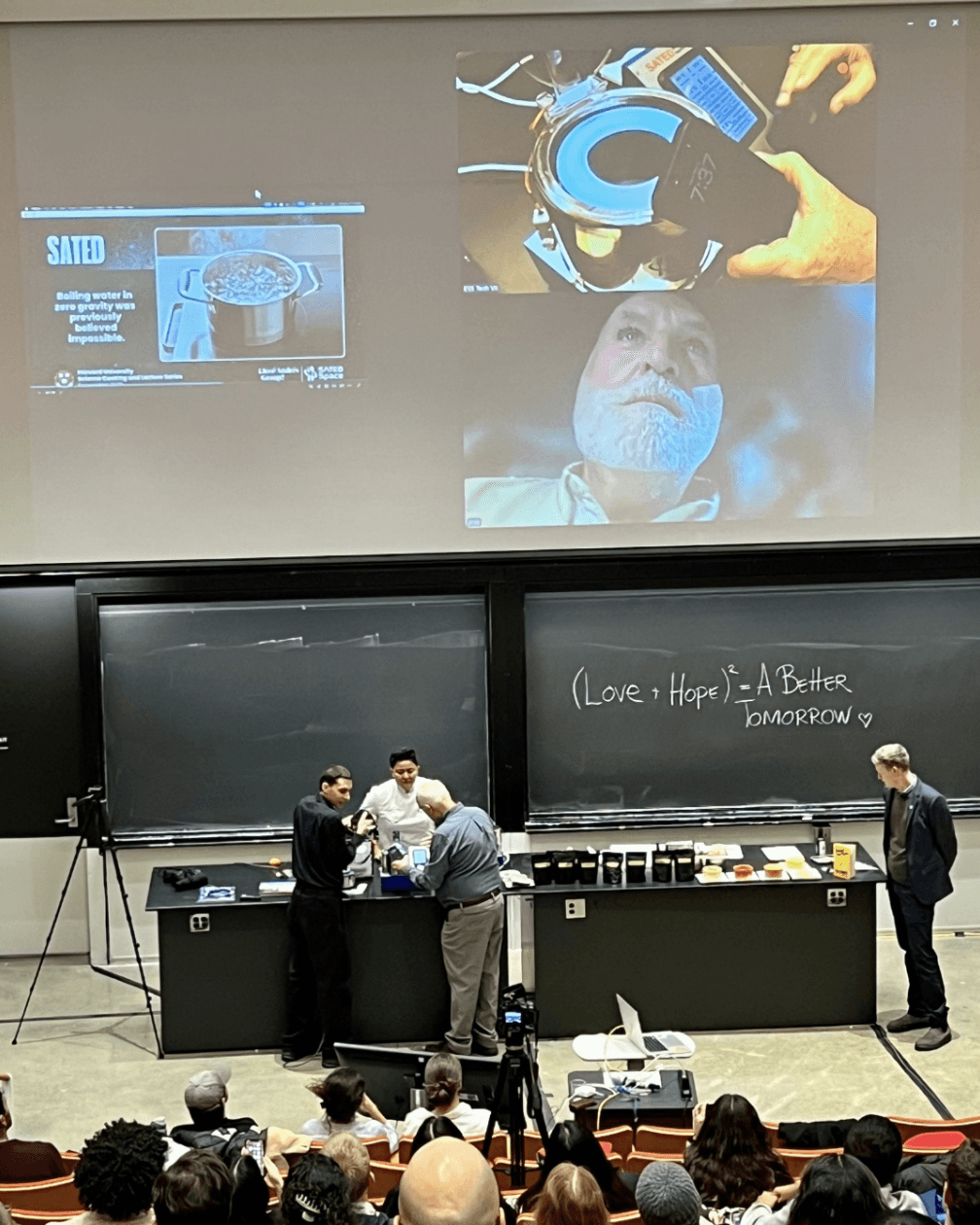
My hope was restored when I saw hundreds of people lining up for Harvard University’s Science and Cooking Lecture Series featuring SATED Space and the José Andés Group.
A Weakened Workforce Leads to Weaker Missions
The erosion of STEM is an academic problem that carries real consequences:
Fewer innovators are entering aerospace, food science, engineering, and human-factors research
A shrinking pool of astronauts and mission specialists
Less diversity among the people who could go to space
Fewer breakthroughs that improve life both off-planet and on Earth
If we fail to inspire the next generation to see themselves in STEM, we have failed the prerequisite course for exploration. We limit who can explore the universe—not because of a lack of talent, but because we never sparked their curiosity.
Food Makes STEM Relevant
Harvard University’s Science & Cooking Lecture Series showcases what happens when STEM intersects with a topic everyone loves: food. Specifically, samples of gourmet space cuisine.
Hundreds of people—from students to grandparents to culinary enthusiasts—showed up for a lecture about “Cooking in Space,” a topic that isn't exclusive to aerospace engineers and physics doctorates. Food is universal, and José Andrés believes that eating is a human right (we agree).
SATED Space founder Jim Sears, along with José Andrés Group’s Sam Chapple-Sokol (Senior Editorial Director) and Chef Charisse Grey (Senior Director of Research and Development), highlighted a capital T truth: Food is for everyone—and STEM can be, too.
If a conversation about food can fill a Harvard lecture hall with people from every different background, imagine what actual, warm, delicious, fresh food will do for space exploration.
For more than a decade, the Science and Cooking class and lecture series has explored countless ways to cultivate scientific curiosity in wider audiences through food and cooking. The SATED device, and the new ideas and energy brought by Jim Sears and the José Andrés Group, introduce an entirely new avenue for discovery and engagement. I was impressed by how many new and returning attendees said, “This is so cool, I can’t wait to follow these developments and continue learning more.
— Pia M. Sörensen, PhD
Senior Preceptor in Chemical Engineering and Applied Materials
The United States is Showing the World That Fresh Food in Space Makes Mars Possible
A round trip to Mars takes roughly three years, and even with rigorous training and psychological conditioning, three years of freeze-dried meals would wear down even the strongest spirits. And for the wealthy private citizens preparing vacations in Lower Earth Orbit (LEO), gourmet is the expectation.
Fresh food is mission-critical. SATED Space makes that requirement possible.
During the lecture, Sears demonstrated the first appliance capable of safely boiling water in zero gravity—a breakthrough once thought impossible. Centrifugal force replaces gravity, allowing bubbles to form and rise. By sitting in the front row, Sam joked that the audience had unofficially agreed to the “splash zone” terms and conditions.
Without SATED’s technology, any attempt to boil water in microgravity produces a large, stationary vapor bubble in the liquid because Earth-side buoyant bubbles cannot detach, leading to uneven heat distribution and poor convection. With SATED’s cooking appliance, centrifugal force restores the fluid dynamics that boiling requires—allowing astronauts to enjoy the basics of comfort on long-duration missions, from hot coffee and ramen to pasta, tea, soups, and eventually even fresh-baked meals millions of miles from home.
Targeted Nutrition and Comfort Make Exploration Accessible
During the Q&A, Chef Charisse—the universe’s foremost space chef—explained that historically, only certain people could qualify for spaceflight because dietary restrictions couldn’t be properly accommodated. This exclusivity is pervasive: in U.S. military pilot programs, color vision deficiency is often disqualifying or results in significant limitations on becoming a pilot. Imagine how many lactose-intolerant and gluten-free astronauts are prohibited from space.
She described her experience living in quarantine with astronaut crews, learning each crew member’s preferences, and cooking meals that brought comfort before launch. By crafting personalized Mother’s Day meals for each crew member during her experience, she reinforced the sense of safety at home before departure to the unknown.
Fresh food in space expands the talent pool by offering targeted nutrition. It makes missions more inclusive and heals the homesick spirit. It lets us send more brilliant minds, regardless of dietary needs, to the Moon, to Mars, and beyond.
Food Makes Learning Fun
In the same way food drew hundreds to Harvard, it can bring millions of curious minds back to STEM. STEM is greater than equations on a whiteboard.
It’s the physics of how bubbles form when gravity disappears.
It’s the way heat moves—and misbehaves—in microgravity.
It’s the biology of how human bodies adapt under extreme stress.
It’s the challenge of feeding people in the harshest environment we’ve ever attempted to call “home.”
Every breakthrough enabling us to cook aboard the International Space Station or Tiangong doesn’t stay in orbit—those same discoveries become the smarter appliances, safer materials, and next-generation technologies we use here on Earth.
Why SATED Space Matters
If we want more kids and adults to enter STEM, we must show them STEM is not an abstract concept—it’s delicious, and greatly benefits all of humanity.
If we want to send more humans to the Moon and Mars, we must give them comfort and community.
If we want America to lead in the new space race, we need innovation and inspiration that all people can relate to. Making pizza in zero gravity can help the United States inspire the world.
Fresh food in space is more than a meal or menu. It’s a mission.
SATED makes space exploration possible.
Together with the brilliant, curious minds in the Harvard lecture hall and culinary geniuses at the José Andés Group, we can make STEM irresistible.
Get in touch